Reference audit of 100 theses approved in 2026
We audited 100 theses drawn at random from those approved in 2026 by the Turkish Council of Higher Education (YÖK) National Thesis Centre. Every one of the 13,961 references in these theses — from 60 different universities — was checked one by one against open scholarly databases.
Finding
In one out of every two theses — 53 of them — at least one reference carried a broken digital object identifier: 369 references had a DOI that resolved to nothing at all, and 77 had a DOI pointing to a completely different publication. At the same time 47 theses contained no suspicious reference whatsoever; the distribution is sharp, with a single thesis accounting for 58 suspicious references.
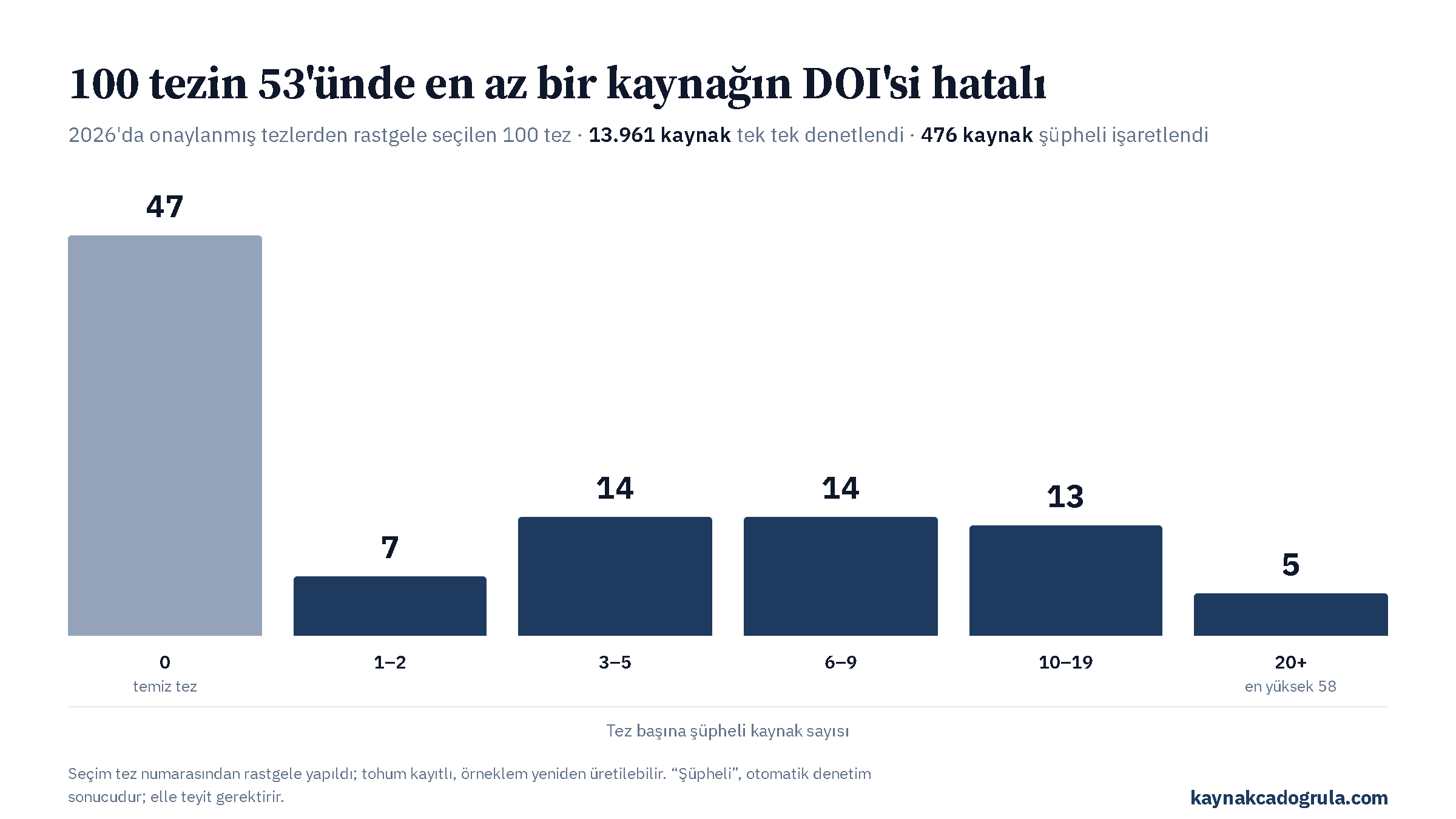
Each column groups theses by how many suspicious references they contain; the grey column is theses with none.
How it was done
The sample was drawn by thesis number
Theses were selected at random by their national thesis number rather than by archive or university, so no institution, field or repository is over-represented. The random seed (20260920) is on record: a third party can reproduce the same 100 theses.
Full texts came from open access
All full texts were downloaded from the YÖK National Thesis Centre, from copies the authors had released for open access; the reference section was extracted and each entry queried separately.
The audit is deterministic
No generative AI was involved in the verification verdict: each entry was compared with Crossref, PubMed, Europe PMC, DOAJ, DataCite, Google Books and the Turkish national indexes, and every DOI was resolved.
The report is anonymous
No thesis, author or supervisor name was recorded at any point. The published dataset contains only thesis type, year and counts; none of the universities is named individually.
What “not verified” means
Not all of the 3,872 unverified references are faulty. The largest group is records for which no definite match could be established, followed by genuine metadata errors and source types that are not expected to appear in these indexes at all.
| Reason | References |
|---|---|
| Match inconclusive | 1,576 |
| Metadata error (author, year, title) | 1,109 |
| Out of scope (books, theses, web pages) | 981 |
| DOI problem (unresolvable or mismatched) | 456 |
| Not found in any index | 214 |
Which database confirmed the reference?
No single index was relied upon; national catalogues were queried for Turkish-language sources.
| Database | Verified |
|---|---|
| Crossref | 7,372 |
| Google Books | 565 |
| TO-KAT | 432 |
| SOBIAD | 331 |
| TR Dizin | 281 |
| YÖK Ulusal Tez Merkezi | 117 |
Limitations
- “Suspicious” is an automated verdict and requires manual confirmation; on its own it is not proof of fabrication. A DOI may fail to resolve simply because the publisher registered it late.
- Verification rates fall in the humanities: Turkish books, Ottoman-era works and archival documents are absent from open databases and therefore count as “not verified”. This is a limit of coverage, not of the thesis.
- The sample covers only theses released for open access; embargoed theses are outside it.
- The study measures a single year (2026) and contains no comparison with earlier years, so it cannot support claims about an increase or decrease.
Data and reproducibility
Per-thesis results are published as an anonymous dataset: each row carries thesis type, year, reference count, verified/unverified/suspicious counts and a breakdown of problems. No university or thesis title is included.
Audit your own reference list
The same check runs in seconds on your own bibliography: every reference is searched in open databases, and unresolvable DOIs and metadata errors are flagged.